The Big Beginner's Guide to Sodium-Ion Batteries
Sodium-ion batteries have been a research topic for decades. But until recently, most engineers treated them as a curiosity — a backup plan in case lithium supplies got tight. That’s changing fast.
In the last few years, sodium-ion has crossed from lab benches into actual commercial products. Real packs. Real vehicles. Real grid storage deployments. And the questions I get from buyers, integrators, and curious engineers have gone from “is this even real?” to “should I be speccing this into my next system?”
This guide is for anyone who wants to understand sodium-ion from the ground up — what it is, how it works, what it’s good at, and where it still struggles. We’ll cover the chemistry, the materials, the performance numbers, how it stacks up against lithium-ion, and where the market is headed.
No hype. No marketing speak. Just what you need to know.
1.What Is a Sodium-Ion Battery?
1.1 Sodium-Ion Battery Definition
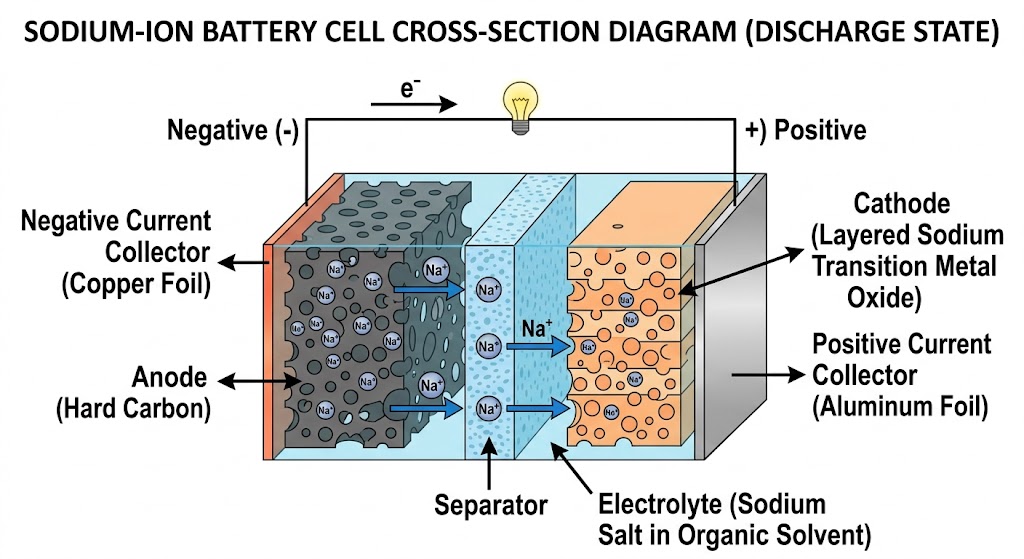
A sodium-ion battery is a rechargeable electrochemical cell that stores and releases energy by moving sodium ions (Na⁺) between a cathode and an anode through an electrolyte. During charging, sodium ions leave the cathode, travel through the electrolyte, and insert into the anode. During discharge, that process reverses — ions flow back, and electrons travel through the external circuit to power the load.
The principle is the same as lithium-ion. The key difference is the working ion: sodium instead of lithium.
1.2 Sodium-Ion Battery Basics
The basic components of a sodium-ion cell are:
- Cathode: The positive electrode, usually a sodium-containing compound
- Anode: The negative electrode, typically hard carbon
- Electrolyte: A sodium salt dissolved in a solvent (or solid-state in some advanced designs)
- Separator: A porous membrane that keeps the electrodes apart while letting ions pass
The cell produces voltage by the difference in electrochemical potential between cathode and anode materials. Typical sodium-ion cells run at 2.5–3.7V depending on the chemistry — slightly lower than lithium-ion, which affects energy density.
1.3 Sodium-Ion Battery Explained for Beginners
Here’s a simple way to think about it. Imagine the battery as a hotel. The ions are the guests. During charging, guests check out of the cathode and check into the anode. During discharge, they check back out of the anode and return to the cathode. Each time a guest moves through the external circuit, they push electrons along with them — that’s the electrical current your device or system uses.
Sodium ions are larger and heavier than lithium ions. This means they don’t always fit as smoothly into the same host materials, which is why sodium-ion development required finding new electrode materials rather than just substituting sodium for lithium in existing lithium-ion designs.
1.4 Why Sodium-Ion Batteries Are Important
Sodium is the sixth most abundant element in Earth’s crust. It’s found in seawater, mineral deposits, and salt beds on every continent. Lithium, by contrast, is concentrated in a handful of countries — Chile, Australia, Argentina, and China hold the majority of global reserves.
When you’re designing a supply chain for battery production at scale, that geographic concentration creates real risk. Sodium-ion doesn’t eliminate every supply chain concern, but it removes one of the biggest single points of failure.
Beyond raw material availability, sodium-ion cells can be made without cobalt and, in some chemistries, without nickel — two metals that carry both supply risk and serious ethical sourcing concerns in the lithium-ion world.
2.How Sodium-Ion Batteries Work
2.1 Sodium-Ion Battery Working Principle
Sodium-ion batteries operate on the same intercalation principle as lithium-ion. The working ion — Na⁺ — intercalates into (inserts between layers of) the electrode material during charging and deintercalates during discharge.
The electrochemical reactions at each electrode produce a voltage difference. That potential difference is what drives current through an external circuit. The electrolyte conducts ions internally while remaining electronically insulating — it moves charge carriers but not electrons.
2.2 How a Sodium-Ion Battery Works
When you plug a sodium-ion battery into a charger:
- The charger applies voltage across the terminals
- Sodium ions are forced out of the cathode material
- Those ions travel through the electrolyte toward the anode
- At the anode, ions insert into the anode material (hard carbon, in most designs)
- Electrons flow through the external circuit from cathode to anode, completing the circuit
When the battery discharges (powers a load):
- Sodium ions leave the anode spontaneously
- They travel back through the electrolyte to the cathode
- Electrons flow through the external circuit from anode to cathode
- That electron flow is the current that powers your system
The battery is “charged” when ions are loaded into the anode and “discharged” when they’ve returned to the cathode.
2.3 Sodium-Ion Battery Charge and Discharge Process
One practical difference from lithium-ion: sodium-ion cells can typically be discharged down to 0V without permanent damage to the cell structure. This is a meaningful advantage for shipping and long-term storage — lithium-ion cells must be stored at partial charge to avoid damage from deep self-discharge.
The charge and discharge efficiency (coulombic efficiency) of mature sodium-ion cells is now above 99% per cycle in commercial designs, which is comparable to lithium-ion in real-world operation.
2.4 Sodium-Ion Battery Cell Structure
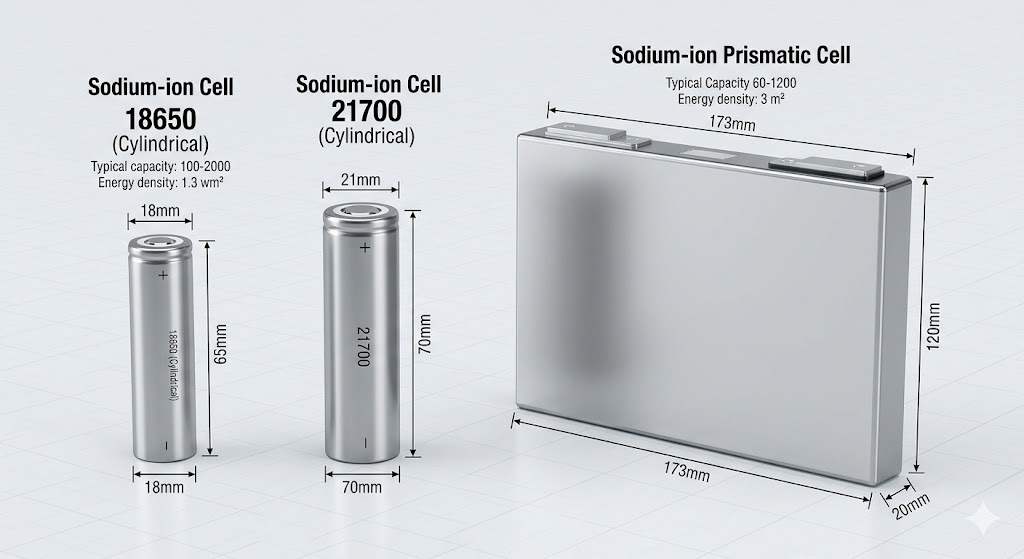
Sodium-ion cells use the same physical formats as lithium-ion — cylindrical (18650, 21700,32140 ), prismatic, and pouch cells. This compatibility is not accidental. Many manufacturers designed sodium-ion cells to fit existing lithium-ion production equipment, which lowers the cost of scaling up.
The internal structure follows the same jellyroll or stacked-layer design used in lithium-ion, with separator, cathode, and anode layers wound or stacked together and immersed in electrolyte.
2.5 Sodium-Ion Battery Chemistry
The overall chemistry is governed by the sodium insertion potential of the cathode and anode materials. Cathode potentials for sodium-ion materials typically fall between 2.0–4.0V vs. Na/Na⁺, while hard carbon anodes typically operate between 0–0.3V vs. Na/Na⁺.
The chemistry is still maturing. Researchers are actively working on electrolyte additives that improve solid-electrolyte interphase (SEI) formation on the anode surface — this SEI layer is critical for cycle life, just as it is in lithium-ion cells.
3.Key Materials Used in Sodium-Ion Batteries
3.1 Cathode Materials in Sodium-Ion Batteries
The cathode is where much of the engineering work in sodium-ion development has focused. There is no single dominant cathode material the way LFP has become dominant in lithium-ion stationary storage. Three main families are in commercial use or advanced development:
Prussian Blue Cathode
Prussian blue analogs (PBAs) are iron-based materials with an open framework structure. The large interstitial sites in the crystal lattice accommodate sodium ions easily — more so than many lithium cathode materials accommodate lithium.
Advantages:
- Very low raw material cost (iron and manganese-based)
- No cobalt or nickel required
- Simple synthesis process
- Good rate capability (fast charge/discharge)
Limitations:
- Water content in the structure can reduce cycle life if not carefully controlled
- Energy density is lower than layered oxide cathodes
Sodium Chloride (common salt) and iron sulfate are among the cheapest inputs used. From a materials cost perspective, Prussian blue cathodes are the most compelling option.
Layered Oxide Cathode
Layered oxides for sodium-ion batteries have the general formula NaMO₂ or Na_xMO₂, where M is a transition metal like iron, manganese, nickel, or copper. These materials offer higher energy density than Prussian blue analogs.
Advantages:
- Higher voltage and energy density
- Well-understood synthesis routes (similar to NMC/NCA layered cathodes in lithium-ion)
Limitations:
- Some compositions include nickel or manganese that can cause structural instability at high states of charge
- Air and moisture sensitivity can complicate manufacturing
Iron-manganese layered oxides are the most promising low-cost version — no nickel, no cobalt.
Polyanion Cathode
Polyanion cathodes contain complex anion groups like phosphate (PO₄³⁻) or sulfate (SO₄²⁻) alongside sodium and transition metals. The most studied is NASICON-type Na₃V₂(PO₄)₃.
Advantages:
- Excellent structural stability
- Good cycle life
- Flat discharge voltage profile (easier battery management)
Limitations:
- Lower electronic conductivity (requires carbon coating)
- Vanadium-based materials raise cost and toxicity concerns
- Lower volumetric energy density
3.2 Anode Materials in Sodium-Ion Batteries
Hard Carbon Anode
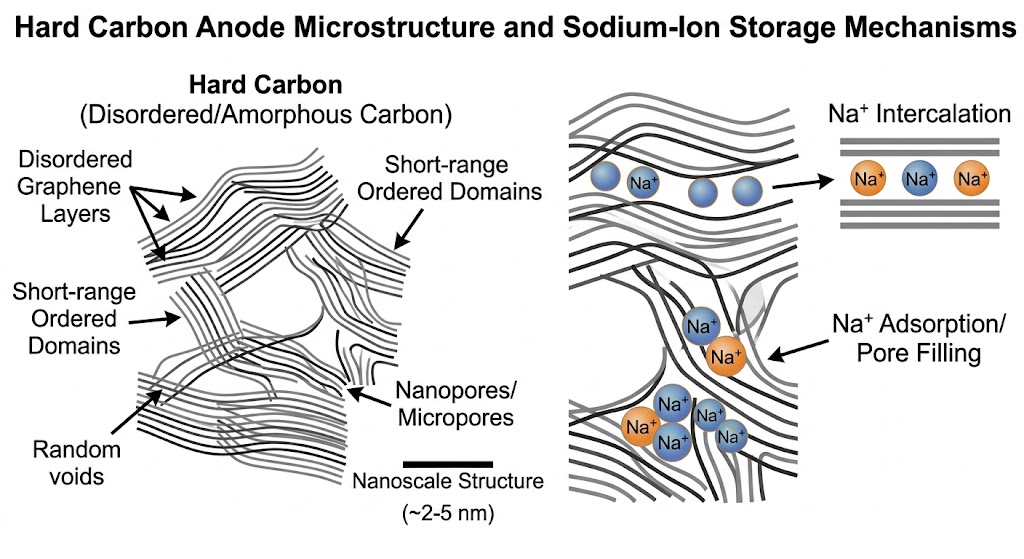
Hard carbon is the dominant anode material for commercial sodium-ion batteries today. It’s a disordered, non-graphitizable carbon produced by pyrolysis of organic precursors — biomass, resins, or polymer waste are common feedstocks.
Unlike graphite (the standard lithium-ion anode), graphite doesn’t work well with sodium ions under normal conditions. Sodium ions are too large to fit efficiently between graphite layers. Hard carbon’s disordered structure, with wider interlayer spacing and micropores, gives sodium ions multiple insertion sites.
What hard carbon gets right:
- Sodium storage capacity of 250–350 mAh/g (approaching graphite’s 372 mAh/g for lithium)
- Good cycle stability in optimized formulations
- Produced from abundant, low-cost carbon precursors
- Capacity to use agricultural or industrial waste streams as feedstock
Current development focus: The initial coulombic efficiency (ICE) of hard carbon anodes — the percentage of sodium that inserts and comes back out in the first cycle — is still lower than graphite’s performance with lithium. Improving ICE from the current 85–90% range toward 92%+ is a key optimization target.
3.3 Electrolyte in Sodium-Ion Batteries
The electrolyte in most commercial sodium-ion batteries is a sodium salt dissolved in an organic solvent — for example, sodium hexafluorophosphate (NaPF₆) or sodium perchlorate (NaClO₄) in carbonate-based solvents.
The challenge: sodium salts are generally less soluble and less stable than their lithium counterparts, and the SEI layer that forms on the anode surface behaves differently with sodium. Getting a stable, thin, ionically conductive SEI is essential for long cycle life.
Solid-state electrolytes for sodium-ion are in research but not yet commercial. Ionic liquid electrolytes are being explored for high-temperature or specialized applications.
The electrolyte formulation has a large influence on:
- Operating temperature range
- Rate capability (how fast the battery can charge and discharge)
- Cycle life
- Safety behavior under abuse conditions
4.Why Sodium-Ion Batteries Matter in the Battery Industry
Alternative to Lithium-Ion Batteries
Sodium-ion is the first rechargeable chemistry to reach commercial scale that can genuinely stand as an alternative to lithium-ion for certain applications — not a replacement in all cases, but a viable option where energy density requirements are moderate and cost or supply chain resilience is a priority.
That’s a significant milestone. Lead-acid, nickel-metal hydride, and other alternatives exist, but none offered the same combination of cycle life, efficiency, and scalability that lithium-ion does. Sodium-ion comes close enough on performance while offering distinct materials advantages.
Battery Supply Chain Diversification
Ask any battery supply chain manager about their biggest risk and they’ll likely mention lithium carbonate prices or cathode material availability. The lithium market saw massive price swings between 2020 and 2023 — spot prices increased more than 10x before collapsing back. That kind of volatility makes product cost planning very difficult.
Sodium-ion doesn’t eliminate supply risk, but it adds an alternative. A manufacturer who can build sodium-ion or lithium-ion packs has more flexibility to respond to market conditions.
More Abundant Battery Materials
Sodium is genuinely abundant — seawater is roughly 30 g/L of sodium. The transition metals used in sodium-ion cathodes (iron, manganese) are among the most common elements in Earth’s crust. The anode precursors (organic carbon sources) are available worldwide.
This doesn’t mean sodium-ion is “free to produce” — processing, manufacturing, and quality control all cost money. But the raw material ceiling is much higher. There’s no realistic scenario where sodium supply limits battery production at global scale.
Lower Resource Risk
Beyond abundance, the geographic distribution of sodium resources is far more even than lithium or cobalt. This reduces geopolitical concentration risk and the kind of single-supplier dependencies that keep procurement teams awake at night.
Cobalt-Free Battery Option
Cobalt has been one of the most problematic materials in the battery industry — high cost, concentrated in the Democratic Republic of Congo, and associated with serious human rights issues in artisanal mining. Lithium-ion has been moving away from cobalt (LFP uses none; NMC chemistries have reduced cobalt content), but sodium-ion cathodes can achieve comparable performance without cobalt entirely.
For companies with strong ESG requirements or responsible sourcing commitments, sodium-ion offers a cleaner materials story.
Nickel-Free Battery Chemistry
Some sodium-ion cathode chemistries — Prussian blue analogs and iron-manganese layered oxides, in particular — also avoid nickel. Nickel has its own supply and price risks, and nickel mining has significant environmental impact. A sodium-ion pack built on PBA cathode and hard carbon anode uses neither cobalt nor nickel.
5.Key Features and Advantages of Sodium-Ion Batteries
Abundant Raw Materials
This is the foundational advantage and worth repeating in concrete terms. The primary materials in a sodium-ion pack — sodium carbonate, iron, manganese, and hard carbon — are commodity materials available from multiple suppliers on every continent. The cost floor for sodium-ion is structurally lower than lithium-ion because the inputs are more abundant and geographically distributed.
Lower Cost Battery Chemistry
Current commercial sodium-ion cells are cost-competitive with LFP at the cell level in some configurations, and the trajectory is downward as production scales. The cost gap vs. lithium-ion has narrowed faster than many analysts expected, driven by pack-level engineering (sodium-ion doesn’t need the same thermal management intensity) and falling hard carbon costs as production ramps.
Cells are not yet cheaper in every market — in 2025-2026, LFP at scale is still very competitive. But at smaller volumes, sodium-ion can already match or beat LFP pricing.
Sustainable Battery Technology
Lower carbon intensity from raw material extraction, the potential to use agricultural waste as hard carbon precursors, and the elimination of cobalt and nickel all contribute to a more sustainable production profile. Life cycle analysis work is still ongoing, but early results suggest sodium-ion has a meaningfully lower environmental burden per kWh than NMC chemistries.
Low Temperature Performance
This is one of sodium-ion’s clearest real-world advantages. At temperatures below -20°C, lithium-ion batteries lose capacity rapidly and can suffer lithium plating on the anode during charging, which is both a performance and safety issue.
Sodium ions have different solvation behavior in cold electrolytes. Commercial sodium-ion cells retain 70–80% of rated capacity at -20°C and can maintain operation down to -40°C in some formulations. For applications in cold climates — outdoor energy storage, vehicles in northern latitudes, industrial equipment in cold environments — this is a genuine operational advantage.
Thermal Stability
The crystal structures used in sodium-ion cathodes — particularly Prussian blue analogs and polyanion types — are thermally stable at higher temperatures than NMC or NCA cathode materials. The onset of exothermic decomposition is higher, which translates to a larger safety margin under abuse conditions.
This doesn’t mean sodium-ion cells are immune to thermal runaway, but the thermal profile under nail penetration, overcharge, or short circuit testing is generally less severe.
Battery Safety
Combining better thermal stability with the ability to discharge to 0V for safe shipping and storage, sodium-ion has a safety profile that is well-suited for consumer applications and transportation. Early regulatory testing has produced encouraging results, though this varies by specific cell chemistry and design.
Long Cycle Life
Layered oxide and Prussian blue cathodes combined with optimized hard carbon anodes are demonstrating 2,000–4,000 cycles at 80% capacity retention in commercial products. Polyanion chemistries push toward the higher end of that range. For stationary storage applications where 10–15 year service life is expected, this is sufficient for many use cases today, and improving.
Fast Charging Potential
Sodium ions diffuse quickly through certain cathode materials, and hard carbon anodes tolerate high-rate charging better than graphite under some conditions. Several commercial sodium-ion designs support C/2 to 2C charging rates, and some cells are rated for 4C or higher pulse charging. The fundamental electrochemistry is favorable for fast charging, though full commercial fast-charge products are still maturing.
6.Limitations and Challenges of Sodium-Ion Batteries
Disadvantages of Sodium-Ion Batteries
No battery chemistry is without trade-offs. Sodium-ion has real limitations that are important to understand before selecting it for an application.
Lower Energy Density Problem
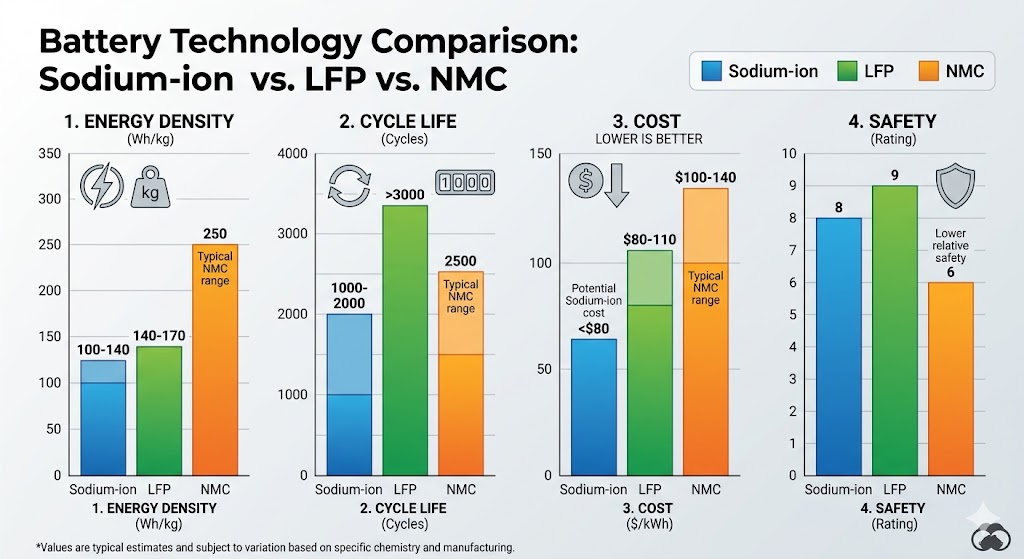
This is the primary limitation. Today’s commercial sodium-ion cells achieve 100–160 Wh/kg at the cell level, with some advanced cells approaching 200 Wh/kg. By comparison, LFP cells commonly deliver 150–200 Wh/kg, and NMC cells reach 200–280 Wh/kg.
The lower energy density comes from two factors:
- Sodium ions are heavier than lithium ions (23 g/mol vs. 6.9 g/mol)
- The electrode materials currently available for sodium storage have lower capacity or voltage than the best lithium cathode materials
For weight-sensitive applications — especially EVs competing on range — this is a meaningful disadvantage. For stationary storage where weight is less critical, it matters less.
Commercial Scale Challenges
Sodium-ion production is still ramping up. CATL began commercial sodium-ion cell production in 2023. Other manufacturers are at earlier stages. At lower production volumes, economies of scale don’t yet fully apply, which affects per-cell pricing.
Equipment compatibility with lithium-ion production lines helps, but electrode processing (particularly hard carbon slurry formulation and coating) has its own learning curve. Yield improvements and production efficiency gains are ongoing.
Material and Manufacturing Challenges
Hard carbon production quality varies significantly by precursor and pyrolysis process. Controlling micropore structure, surface chemistry, and interlayer spacing requires process discipline. Inconsistency in hard carbon quality directly affects cell performance and cycle life — this is one reason why some sodium-ion cells from different manufacturers vary more than LFP cells do.
Prussian blue analogs are sensitive to water content during synthesis and cell assembly. Managing this at scale adds complexity.
Infrastructure and Adoption Barriers
Battery management systems designed for lithium-ion chemistry need software adjustment to work optimally with sodium-ion cells — different voltage profiles, different state-of-charge estimation curves, different temperature behavior. For systems integrators, this means validation work before sodium-ion can be swapped into an existing platform.
Charging infrastructure operates at voltage ranges designed for lithium-ion. While sodium-ion cells can use the same physical connectors, charging protocols may need calibration.
Market Competition with Lithium-Ion
LFP lithium-ion is an aggressive competitor. The global LFP supply chain is deeply optimized, production is at massive scale, and LFP prices have fallen substantially. At current market prices, sodium-ion’s cost advantage over LFP is smaller than early projections suggested. The window of competitive advantage depends heavily on lithium carbonate prices — when lithium is cheap, LFP competes harder on cost.
7.Sodium-Ion Battery Performance Explained
Sodium-Ion Battery Energy Density
| Cell Format | Typical Range (2025–2026) |
|---|---|
| Gravimetric (Wh/kg) | 100–160 Wh/kg cell level |
| Volumetric (Wh/L) | 200–350 Wh/L depending on format |
| Advanced cells (development) | 180–220 Wh/kg |
These numbers will improve. The theoretical energy density ceiling for sodium-ion, while lower than lithium-ion, is not as constraining as it seems for non-automotive applications.
Sodium-Ion Battery Voltage
Nominal cell voltage for sodium-ion depends on cathode chemistry:
- Prussian blue cathode: ~3.2 V
- Layered oxide (iron-manganese): ~3.2–3.5 V
- Polyanion (NASICON type): ~3.3 V
Compare to LFP: 3.2 V nominal. The voltage gap vs. lithium-ion is present but not as large as many assume. NMC is ~3.6–3.7 V, giving it a larger advantage.
Sodium-Ion Battery Capacity
At the cell level, commercial cells are available in 50–200 Ah formats for prismatic designs. Energy per cell ranges from around 150 Wh to over 600 Wh in large prismatic formats being developed for grid storage.
Sodium-Ion Battery Efficiency
Round-trip energy efficiency (charge-discharge at moderate C-rate) is typically 90–95% for commercial cells at room temperature — comparable to LFP. At low temperatures or high C-rates, efficiency drops somewhat, as it does with any chemistry.
Sodium-Ion Battery Cycle Life
Commercial designs today:
- Prussian blue cathode: 4,000+ cycles at 80% retention (some manufacturers claim)
- Layered oxide: 2,000–3,000 cycles typical
- Polyanion: 3,000–5,000 cycles in laboratory conditions; fewer in commercial cells
For reference, LFP commercial cells typically deliver 2,000–4,000 cycles at 80% DoD. Sodium-ion cycle life is already within the range needed for most stationary storage applications.
Sodium-Ion Battery Operating Temperature
| Parameter | Typical Range |
|---|---|
| Charging temperature | 0°C to 45°C |
| Discharging temperature | -40°C to 60°C |
| Storage temperature | -20°C to 35°C recommended |
The discharge range is notably wider than most LFP cells, particularly at the cold end.
Low Temperature Battery Performance
At -20°C, sodium-ion cells retain approximately 70–80% of room temperature capacity. At -30°C, some commercial cells still deliver 60–70%. LFP cells typically drop to 60–70% at -20°C and struggle significantly below that.
This difference is consistent across cathode chemistries and stems from the sodium ion’s desolvation behavior and transport properties in cold electrolytes.
Power Density of Sodium-Ion Batteries
Power density (W/kg or W/L) is competitive with LFP in most commercial designs. Some PBA-based cells show strong rate capability — partly because the open framework structure of Prussian blue allows rapid ion transport.
Practical C-rate capability:
- Standard commercial cells: 1C–2C continuous charge/discharge
- High-rate cells: 3C–5C pulse
- Roadmap targets: some designs targeting 5C–10C for specific applications
8.Sodium-Ion Battery vs Lithium-Ion Battery
What Is the Difference Between Sodium-Ion and Lithium-Ion Batteries?
The core difference is the charge carrier: Na⁺ vs. Li⁺. Sodium is larger (ionic radius: 1.02 Å vs. 0.76 Å for lithium) and heavier. This affects which electrode materials work, what voltage the cells produce, and how they behave at temperature extremes.
The manufacturing process is similar enough that existing lithium-ion production equipment can be adapted for sodium-ion — a major advantage for scaling up production quickly.
Sodium-Ion vs Lithium-Ion Comparison Table
| Property | Sodium-Ion | LFP (Li-Ion) | NMC (Li-Ion) |
|---|---|---|---|
| Gravimetric Energy Density | 100–160 Wh/kg | 150–200 Wh/kg | 200–280 Wh/kg |
| Nominal Voltage | ~3.2–3.5 V | 3.2 V | 3.6–3.7 V |
| Cycle Life (80% retention) | 2,000–4,000 | 2,000–4,000 | 1,000–2,000 |
| Cold Temp. Performance (-20°C) | 70–80% capacity | 60–70% capacity | 50–65% capacity |
| Thermal Stability | Good–Excellent | Good | Moderate |
| Cobalt Content | None | None | Moderate (reduced) |
| Raw Material Risk | Low | Low–Moderate | Moderate–High |
| Estimated Cell Cost Trajectory | Declining | Declining | Moderate |
| Discharge to 0V | Yes (safe) | No | No |
Sodium-Ion Battery vs LFP Battery
LFP is sodium-ion’s most direct competitor in the cost-sensitive, safety-focused market segment. Both are cobalt-free. Both have good cycle life. LFP has a meaningful energy density advantage today. Sodium-ion has a better cold-weather performance advantage and potentially lower long-term material cost ceiling.
For stationary storage in cold climates, sodium-ion can already compete with LFP on real-world performance. For most other applications, LFP remains more mature and often more cost-effective in 2025-2026.
Energy Density Comparison
Sodium-ion trails LFP by roughly 20–30% gravimetrically in current commercial cells. This gap will narrow as sodium-ion matures, but a fundamental gap will likely persist due to the heavier sodium ion and lower electrode potential of current anode materials.
Cycle Life Comparison
Both LFP and the best sodium-ion chemistries (PBA and polyanion cathodes) target 2,000–4,000 cycles at 80% DoD. For a 10-year stationary storage system cycling once daily, you need approximately 3,650 cycles. Both chemistries are approaching or meeting this target.
Cost Comparison
At the raw material level, sodium-ion has a structural cost advantage. At the cell manufacturing level, lithium-ion (especially LFP) has the advantage of much larger-scale production. In 2025-2026, the two are roughly competitive at the pack level for some applications, with LFP still ahead in high-volume markets.
Safety Comparison
Both sodium-ion and LFP have better safety profiles than NMC or NCA. Sodium-ion’s thermal stability edge over LFP is real but incremental — not transformative for most application scenarios. Both can be designed into safe systems with proper BMS and thermal management.
Cold Weather Performance Comparison
This is where sodium-ion wins clearly. At -20°C to -40°C, sodium-ion cells deliver meaningfully more usable capacity than LFP. For outdoor systems in cold climates — particularly without active heating — this translates into real-world range or capacity improvement.
Charging Performance Comparison
LFP has more commercial fast-charging products available today due to market maturity. Sodium-ion’s fundamental electrochemistry is favorable for fast charging, and some commercial cells already support 2C–4C rates. Expect this to improve as the chemistry matures.
Material Availability Comparison
LFP uses lithium and iron phosphate. Sodium-ion uses sodium, carbon, iron, and manganese. Sodium is more abundant and less geographically concentrated than lithium. For supply chain resilience, sodium-ion has a meaningful long-term advantage.
9.Applications of Sodium-Ion Batteries
What Are Sodium-Ion Batteries Used For?
Sodium-ion batteries are finding their first commercial applications in stationary energy storage and low-speed EVs. Higher-performance applications like passenger EVs and consumer electronics are following as energy density improves.
Sodium-Ion Battery for Energy Storage
Stationary energy storage is the most commercially mature application for sodium-ion today. Grid-scale and community-scale projects are operating in China, Europe, and elsewhere. The combination of competitive cost, acceptable energy density (physical size is less constrained for ground-mounted systems), and good cycle life makes stationary storage a natural fit.
Sodium-Ion Battery for Solar Storage
Pairing sodium-ion storage with solar generation is a compelling use case. Solar installations often need to absorb burst generation in the middle of the day and dispatch it in the evening — the daily cycling pattern that sodium-ion handles well.
In climates with cold winters, sodium-ion’s low-temperature performance means the system keeps working when temperatures drop — something that causes real degradation in LFP-based systems without active heating.
Sodium-Ion Battery for Grid Storage
Utility-scale grid storage benefits from sodium-ion’s cycle life, safety, and the potential for local supply chains (if cathode and anode materials can be sourced domestically). Several large-scale sodium-ion grid storage projects came online in 2024–2026, particularly in China.
Sodium-Ion Battery for Home Energy Storage
Home energy storage is an emerging market for sodium-ion. Products like home backup systems and solar + storage units are beginning to appear with sodium-ion chemistries. The safety profile (better thermal stability, lower likelihood of severe thermal runaway) is attractive for indoor or garage-mounted residential installations.
Sodium-Ion Battery for Backup Power
Uninterruptible power supply (UPS) and backup power applications match sodium-ion’s strengths well. The chemistry handles deep discharge, doesn’t require active temperature management across most operating environments, and can tolerate sitting at low state-of-charge between discharge events better than some lithium chemistries.
Sodium-Ion Battery for EVs
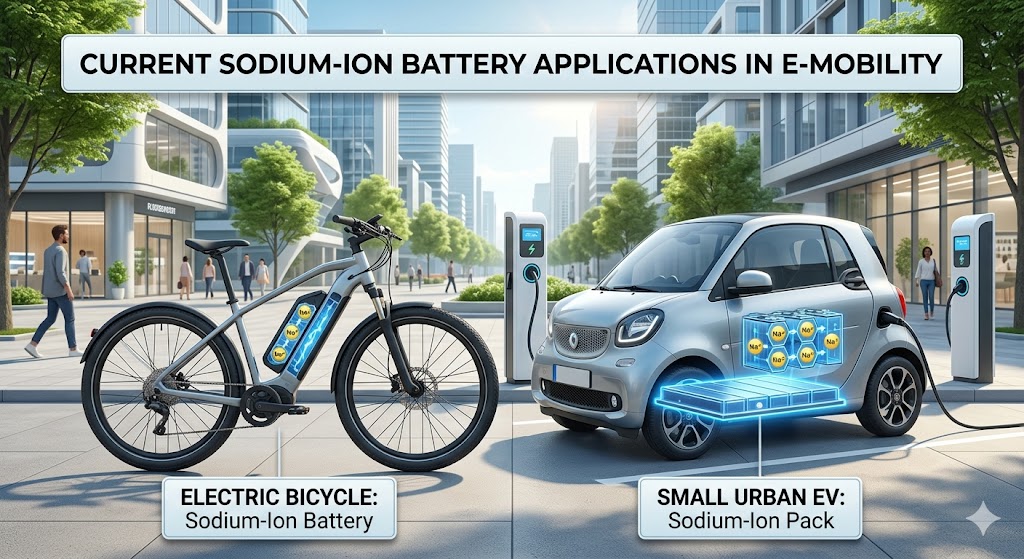
Electric vehicle use is the most discussed and most demanding application for sodium-ion. The lower energy density means more cells are needed for a given range, which adds weight and cost. Despite this, sodium-ion EV products are already in production:
- Low-speed EVs (electric bicycles, golf carts, small city vehicles) where range requirements are modest
- Short-range urban EVs where the energy density limitation is manageable
- Hybrid configurations (sodium-ion + high-density lithium cells) being explored for specific segment needs
CATL has announced sodium-ion cells in production vehicles. The first generation targets lower-range vehicles in the Chinese market. Future generations with higher energy density will expand the addressable EV market.
Sodium-Ion Battery for E-Mobility
E-bikes, e-scooters, electric motorcycles, and light electric vehicles are well-matched to sodium-ion’s current capability. The range required per charge is low enough that the energy density limitation doesn’t matter much, and the cost and safety advantages are meaningful in mass-market consumer products.
Sodium-Ion Battery for Portable Power Stations
Portable power stations (the kind used for camping, job sites, or emergency backup) are an interesting near-term market. Safety matters for products that are used indoors or carried in vehicles. The ability to ship cells at 0V simplifies logistics. Energy density limitations are manageable at the portable power station form factor.
Sodium-Ion Battery for Consumer Electronics
Phones, laptops, and tablets are the hardest application for sodium-ion’s current energy density. These products are extremely space- and weight-constrained, and the energy density gap vs. NMC or NCA lithium-ion is most problematic here. Consumer electronics applications will require substantial energy density improvement — likely to 200+ Wh/kg commercially — before sodium-ion is competitive in slim portable devices.
10.Current Development of Sodium-Ion Batteries
State of Sodium-Ion Battery Technology
Sodium-ion has transitioned from laboratory curiosity to commercial production reality. The technology readiness level has moved from proof-of-concept to actual products in the field. That transition happened faster than many in the industry expected, driven primarily by CATL’s announcement and subsequent commercialization.
Commercialization of Sodium-Ion Batteries
The commercialization wave started in earnest around 2021–2022, when CATL announced its first-generation sodium-ion cell. By 2023, production cells were being assembled into packs. By 2024–2026, vehicles and grid storage systems using sodium-ion cells were in operation.
Other companies moving toward commercialization include HiNa Battery Technology (China), Faradion (UK/Saudi Arabia), Natron Energy (USA), Tiamat (France), and several battery manufacturers in Japan and South Korea.
Sodium-Ion Battery Market Trends
The market is growing from a small base but with accelerating momentum. Key trends:
- Grid storage and two-wheel EV applications leading adoption
- Manufacturing scale-up ongoing in China
- Western companies investing in domestic sodium-ion supply chains
- Hard carbon production capacity increasing
- Cost curves following lithium-ion’s early trajectory
Latest Sodium-Ion Battery Developments
As of 2025–2026, the field has seen:
- Commercial cells reaching 160 Wh/kg gravimetric energy density
- Polyanion cathode cells achieving 5,000+ cycle life in controlled testing
- Sodium-ion packs installed in grid-scale storage projects exceeding 100 MWh
- First passenger vehicles with sodium-ion packs entering production in China
Sodium-Ion Battery Companies
Major players as of 2025-2026 include:
Company | Country | Focus Area |
CATL | China | EV + grid storage |
HiNa Battery | China | Grid storage |
Natron Energy | USA | Data center / industrial |
Faradion | UK/Saudi Arabia | Grid + EV |
Tiamat | France | Industrial / grid |
BYD (research) | China | EV exploration |
CATL Sodium-Ion Battery
CATL’s first-generation sodium-ion cell achieved approximately 160 Wh/kg — a benchmark that established what commercial sodium-ion could realistically deliver. CATL announced plans for a second-generation cell with higher energy density. Their strategy involves hybrid battery packs that combine sodium-ion and lithium-ion cells in the same vehicle, letting each chemistry do what it does best (sodium-ion for low-temperature and base load, lithium-ion for peak range).
Sodium-Ion Battery Mass Production
Hard carbon production capacity is the current supply chain constraint. Global hard carbon production has been scaling up from specialty carbon producers in Japan, China, and Europe. As capacity grows, hard carbon pricing will fall, directly improving sodium-ion cell economics.
Electrode manufacturing and cell assembly are following lithium-ion process templates with modifications — the ramp-up curve is faster than starting from scratch.
Sodium-Ion Battery in Electric Vehicles
The first commercial sodium-ion vehicle applications are in China’s domestic market — primarily smaller city cars and two-wheelers. CATL has announced partnerships with several Chinese automakers. The first generation is aimed at shorter-range, more price-sensitive segments.
Longer-range applications and western markets are on the roadmap for later generations with improved energy density.
Sodium-Ion Battery in Energy Storage Systems
Grid storage is already a production reality. Sodium-ion ESS projects are operating at utility scale. The economics for cold-climate or supply-chain-diversified storage projects are competitive today. This application will continue to grow faster than EV adoption in the near term.
11.Can Sodium-Ion Batteries Be Used in Real-World Products Today?
Can Sodium-Ion Batteries Be Used in EVs?
Yes, with caveats. Sodium-ion is in production vehicles today — primarily shorter-range urban EVs in the Chinese market. For longer-range EVs competing on range with 400-600 km targets, sodium-ion’s current energy density makes it challenging without significant pack size increase.
The realistic near-term EV sweet spot for sodium-ion: vehicles with 150–300 km range targets, price-sensitive segments, and applications where cold-weather performance matters.
Can Sodium-Ion Batteries Work in Cold Weather?
Yes — and this is one of sodium-ion’s strongest real-world advantages. Cells maintain 70–80% capacity at -20°C and can operate as low as -40°C in some designs. For applications in northern Canada, Scandinavia, Russia, or high-altitude locations, this matters enormously.
Active thermal management systems required to make LFP work in cold climates add cost, weight, and complexity. Sodium-ion can reduce or eliminate that requirement in some designs.
Are Sodium-Ion Batteries Better Than Lithium-Ion?
“Better” depends on what you’re optimizing for. Sodium-ion is better than lithium-ion for:
- Cold temperature operation
- Supply chain resilience and material availability
- Safety profile
- Applications where weight/size are not the primary constraint
Lithium-ion (especially LFP and NMC) is better for:
- High energy density requirements
- Mature supply chains and manufacturing at massive scale
- Consumer electronics and high-range EVs
Are Sodium-Ion Batteries Cheaper?
At the raw material level, yes. At the production scale available today, it’s application-dependent. For large-format stationary storage projects procured in volume, sodium-ion can already match LFP pricing in some markets. For small quantities or consumer products, LFP’s manufacturing maturity gives it a cost advantage.
The long-term cost trajectory for sodium-ion is favorable. As production scales, the material cost advantage will increasingly translate to cell cost advantage.
12.Are Sodium-Ion Batteries Safe?
Battery Safety and Thermal Stability
Sodium-ion batteries have a favorable safety profile compared to lithium-ion, particularly NMC and NCA chemistries. The cathode materials used in commercial sodium-ion cells — Prussian blue analogs and polyanion structures — are thermally stable at higher temperatures than oxide cathodes used in NMC/NCA.
In abuse testing (nail penetration, overcharge, short circuit), sodium-ion cells generally show:
- Higher onset temperature for exothermic reactions
- Less severe thermal runaway events when they do occur
- Lower gas generation
This doesn’t mean sodium-ion cells are completely immune to failure. Any battery can be abused to failure. But the thermal profile gives a larger safety margin.
How Safe Are Sodium-Ion Batteries Compared with Lithium-Ion?
Against LFP specifically: sodium-ion is broadly comparable in safety, with a modest edge in thermal stability. Both are significantly safer than NMC/NCA.
Against NMC: sodium-ion has a meaningful safety advantage that is relevant for applications where pack design, BMS sophistication, or operating conditions make worst-case safety especially important.
The ability to discharge to 0V is a genuine safety and logistics advantage — cells can be shipped fully discharged, which simplifies transportation compliance.
[IMAGE SUGGESTION: Comparative thermal behavior diagram showing onset temperatures for sodium-ion, LFP, and NMC under abuse conditions] Alt text: Battery safety comparison chart showing thermal runaway onset temperatures for sodium-ion, LFP, and NMC batteries
Safety Considerations in Storage, Charging, and Use
Storage: Sodium-ion cells can be stored at 0V without damage — a meaningful advantage over lithium-ion. For extended storage, 30–50% SOC is still recommended for longevity, but the risk of cell damage from over-discharge during storage is lower.
Charging: Standard precautions apply — don’t charge damaged cells, use a compatible BMS with appropriate voltage cutoffs, and don’t charge below 0°C without proper conditioning protocols (though sodium-ion is more tolerant of low-temperature charging than LFP).
Use: The thermal management requirements for sodium-ion are generally less demanding than NMC/NCA, comparable to LFP. Well-designed packs with appropriate BMS protection are safe for residential, commercial, and industrial applications.
UN transportation regulations (UN 38.3) still apply to sodium-ion cells. Manufacturers conducting this testing and publishing results is a sign of production readiness.
13.Future of Sodium-Ion Batteries
Future of Sodium-Ion Technology
The trajectory is positive, but the pace is important to assess realistically. Sodium-ion won’t displace lithium-ion across the board — the two chemistries will coexist, with sodium-ion taking an increasingly large share of applications where its specific advantages align.
Sodium-Ion Battery Outlook
Near-term (2025–2028):
- Continued energy density improvements toward 180–220 Wh/kg cell level
- Significant growth in grid storage deployments
- Expanding EV applications in short-range and price-sensitive segments
- Hard carbon cost reduction as production scales
- Western manufacturers establishing production
Medium-term (2028–2035):
- Energy density approaching 200–250 Wh/kg in advanced designs
- Meaningful market share in stationary storage globally
- Broader EV applicability as energy density improves
- Potential solid-state sodium-ion designs for higher performance
Sodium-Ion Battery Market Forecast
Multiple analyst groups project the sodium-ion battery market growing from low GWh levels in 2024 to 100+ GWh annually by 2030, concentrated initially in China and then expanding globally. That’s a fast growth curve off a small base. Most of the growth is expected in stationary storage (grid + C&I + residential) and low-speed EVs.
Next Generation Battery Technology
The research pipeline includes:
- Higher-capacity cathode materials (targeting 180+ mAh/g)
- Anode alternatives to hard carbon with better initial coulombic efficiency
- Solid electrolyte systems for sodium-ion solid-state batteries
- Quasi-solid and gel polymer electrolytes for improved safety and temperature range
Future Battery Chemistry Trends
The broader battery market is moving toward abundant-material, lower-cost chemistries as the total installed base scales to terawatt-hour levels. Sodium-ion fits that trend. It’s not alone — lithium-sulfur, lithium-air, and sodium-sulfur are also under development — but sodium-ion is the closest to commercial maturity among the “beyond lithium-ion” alternatives.
Will Sodium-Ion Batteries Replace Lithium-Ion?
No — not in any comprehensive way. The more accurate framing is that sodium-ion will complement lithium-ion by taking applications where it’s better suited: stationary storage, cold-climate deployment, cost-sensitive markets, and cases where supply chain diversification has strategic value.
Lithium-ion will continue dominating high-energy-density applications — consumer electronics, long-range EVs, aerospace, and anywhere that energy density or weight is the primary design constraint.
The future is likely a two-chemistry world where engineers choose based on requirements rather than defaulting to lithium-ion for everything.
14.Sodium-Ion Battery FAQ
14.1 What Is a Sodium-Ion Battery?
A sodium-ion battery is a rechargeable battery that stores and releases energy by moving sodium ions between a cathode and anode. It works on the same electrochemical principles as lithium-ion but uses sodium as the working ion and different electrode materials.
14.2 How Do Sodium-Ion Batteries Work?
Sodium ions (Na⁺) shuttle between the cathode and anode through an electrolyte. During charging, ions move from cathode to anode. During discharge, they return to the cathode, and the electron flow through the external circuit powers the load. The energy stored depends on the voltage difference between cathode and anode materials and the amount of sodium that can be stored.
14.3 Are Sodium-Ion Batteries Safe?
Yes, with an appropriate BMS and proper system design. Sodium-ion batteries have a favorable safety profile — better thermal stability than NMC/NCA, comparable to LFP. They can be safely discharged to 0V for shipping and storage. Commercial cells are tested to UN 38.3 and other relevant standards.
14.4 Are Sodium-Ion Batteries Better Than Lithium-Ion?
It depends on the application. Sodium-ion is better for cold weather, supply chain resilience, and applications where weight and size aren’t the primary constraints. Lithium-ion is better for high energy density, mature supply chain, and consumer electronics. Neither is universally superior.
14.5 Are Sodium-Ion Batteries Cheaper?
In terms of raw material cost potential, yes. In current production pricing, it’s roughly comparable to LFP for large-format stationary storage in some markets. As sodium-ion production scales, the cost gap will widen in sodium-ion’s favor.
14.6 Can Sodium-Ion Batteries Be Used in EVs?
Yes. Sodium-ion EVs are already in production, primarily for shorter-range, cost-sensitive applications in the Chinese market. Longer-range EVs will require continued energy density improvement before sodium-ion is broadly competitive.
14.7 Can Sodium-Ion Batteries Work in Cold Weather?
Yes — and this is one of their strongest advantages. Sodium-ion cells maintain 70–80% capacity at -20°C and can operate down to -40°C in some designs. This is significantly better than LFP and NMC under cold conditions.
14.8 What Are Sodium-Ion Batteries Used For?
Current main applications include grid-scale energy storage, C&I and residential solar storage, low-speed EVs and e-mobility, backup power systems, and portable power stations. Consumer electronics applications are expected to follow as energy density improves.
14.9 What Is the Difference Between Sodium-Ion and Lithium-Ion Batteries?
The primary differences are: (1) sodium-ion uses sodium ions instead of lithium ions; (2) sodium-ion requires different electrode materials (hard carbon anode, new cathode types); (3) sodium-ion has lower energy density; (4) sodium-ion has better cold-temperature performance; (5) sodium-ion uses more abundant, geographically distributed raw materials; (6) sodium-ion can safely discharge to 0V.
15.Final Thoughts on Sodium-Ion Batteries
Who Should Pay Attention to Sodium-Ion Technology?
Energy storage developers and project developers working in cold climates or markets where LFP supply chain diversification has strategic value should be evaluating sodium-ion options now.
OEM engineers and system integrators designing products for cold-weather markets, low-range EVs, or cost-sensitive applications should add sodium-ion to their chemistry evaluation process.
Battery buyers and procurement teams for grid storage, C&I storage, and industrial backup power should request sodium-ion quotes alongside LFP and compare total cost of ownership over the system lifetime — particularly factoring in cold-weather performance if relevant to your deployment geography.
Investors and analysts tracking the battery supply chain will need to understand sodium-ion as it becomes a meaningful segment in energy storage deployments through the late 2020s.
Where Sodium-Ion Batteries Make the Most Sense
Right now, sodium-ion is most competitive in these scenarios:
- Cold-climate stationary storage — outdoor systems in locations with -20°C or colder winters
- Grid and utility storage — where scale, cycle life, and material supply diversity matter
- Low-speed EV applications — e-bikes, city cars, logistics vehicles with short daily ranges
- Cost-sensitive markets — where the long-term material cost advantage is most meaningful
- Supply-chain-resilient designs — for organizations that need to reduce geopolitical material risk
Key Takeaways for Beginners
- Sodium-ion batteries work like lithium-ion but use sodium ions and different electrode materials
- The main real-world advantage today is cold-weather performance and raw material availability
- Energy density trails lithium-ion — this matters for EVs, not much for stationary storage
- Sodium-ion is already in commercial production — this is not a future technology
- It won’t replace lithium-ion wholesale; it will take applications where it fits better
- Costs will continue to fall as production scales — the long-term economics are favorable
- Safety is comparable to or better than LFP; meaningfully better than NMC for thermal stability
Sodium-ion is not the silver bullet that solves every battery problem. But it’s a real, commercially available option that earns a place in the engineer’s toolbox — and that toolkit just got larger.
References for further reading:
- Battery University — sodium-ion battery principles and comparison content
- IEC 62619 — safety requirements for secondary lithium cells (relevant standard context for comparison)
- UN 38.3 — transportation testing standard applicable to sodium-ion cells
- IEC TC21 — ongoing standards work covering emerging battery chemistries