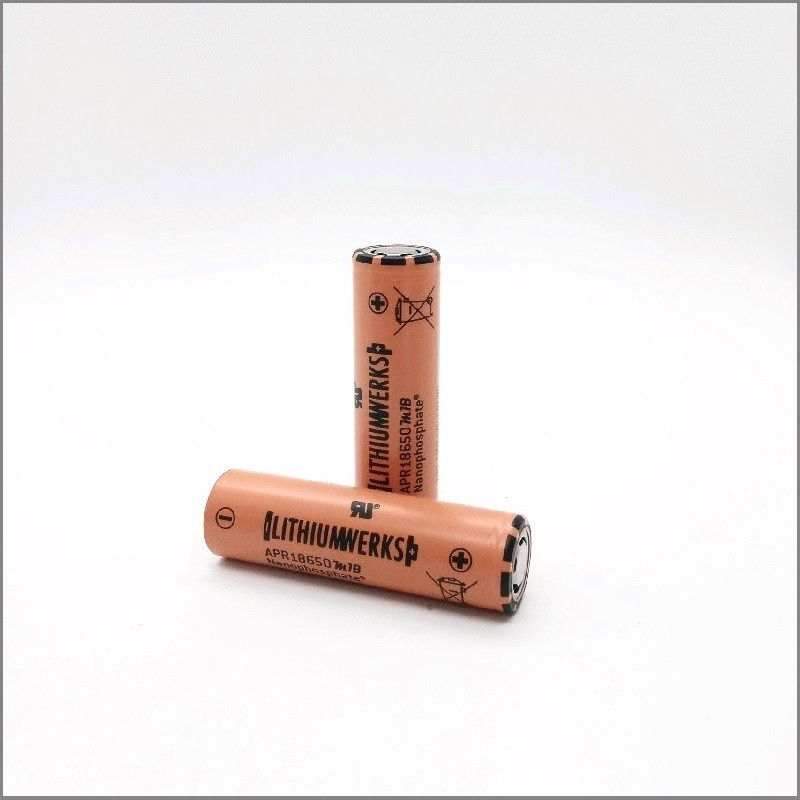
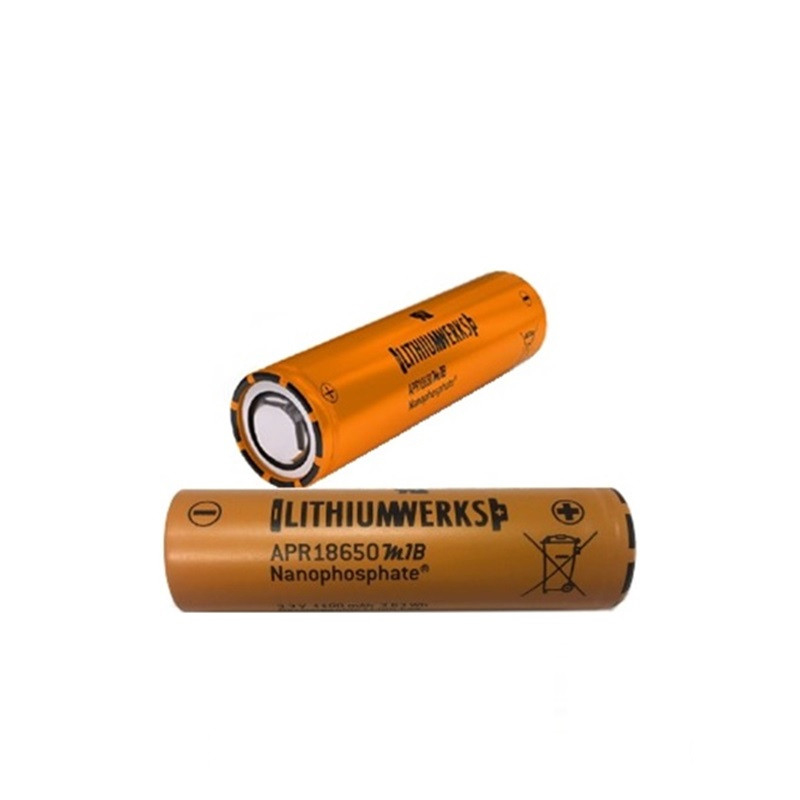
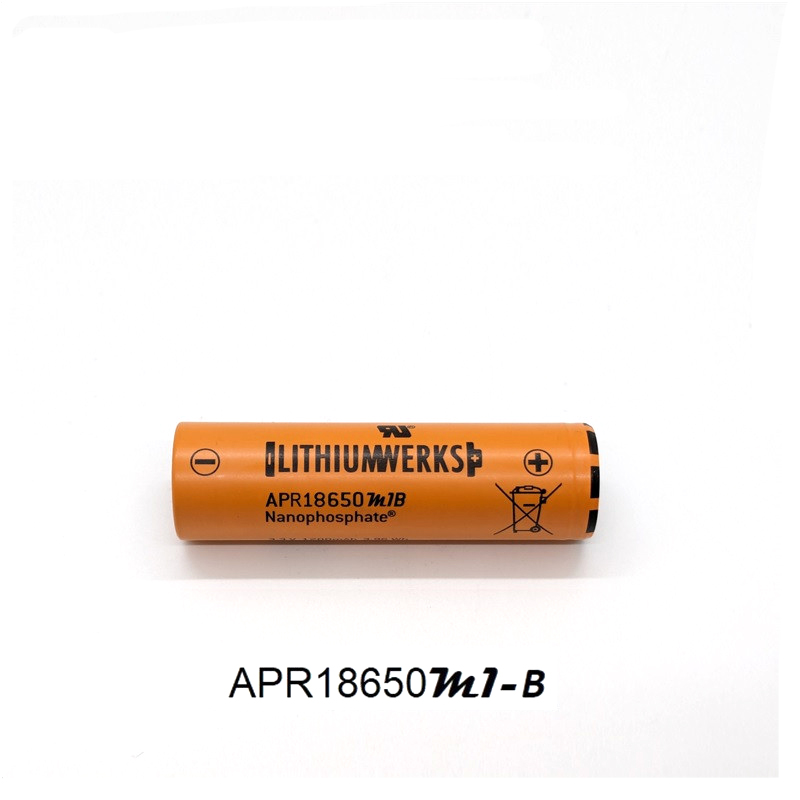
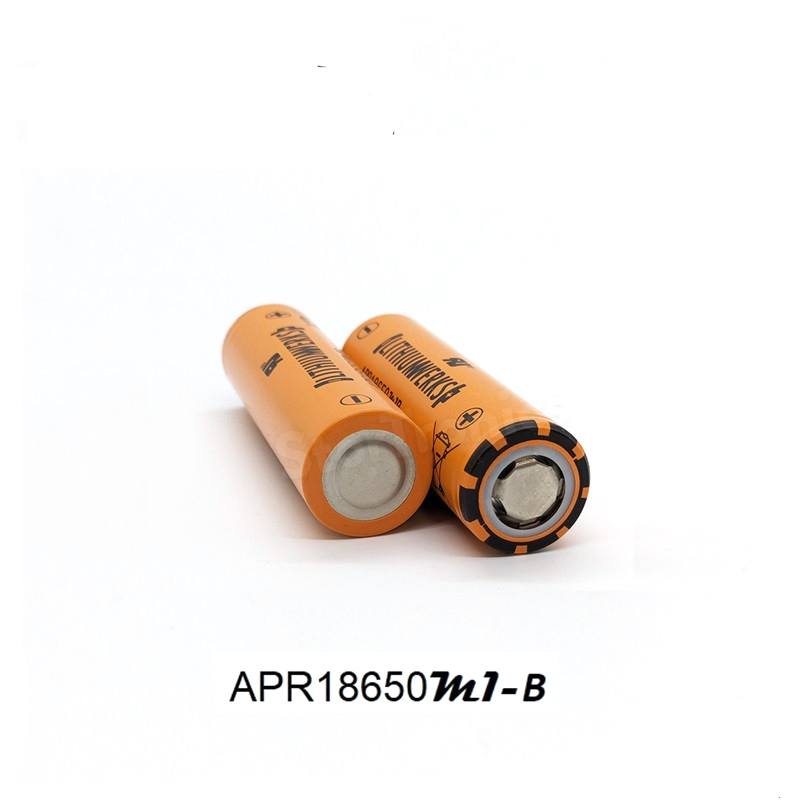
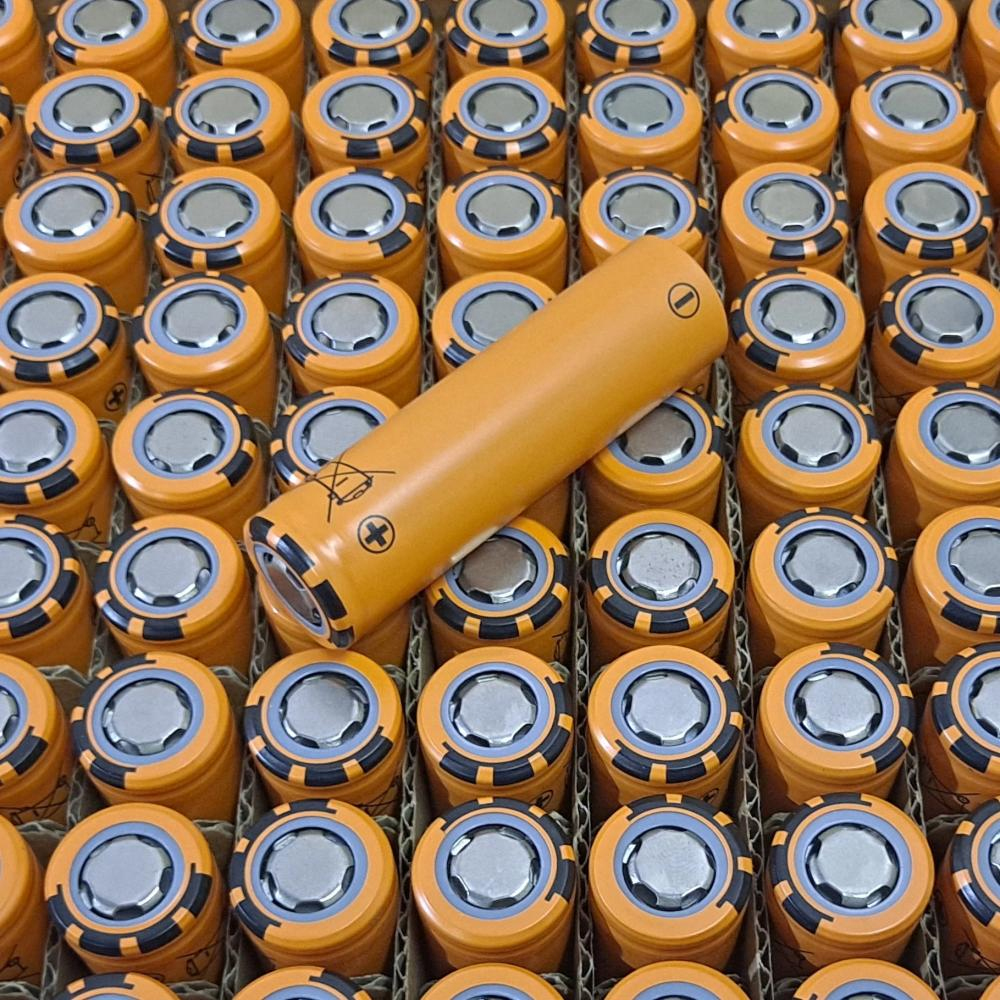
The LithiumWerks APR18650M1B is a 3.3V, 1.2Ah lithium iron phosphate cell built for demanding applications where safety, power density, and long service life all matter. This is a LiFePO4 rechargeable cell in the standard 18650 cylindrical format, engineered around LithiumWerks’ proprietary Nanophosphate battery technology. It delivers 30A continuous discharge and up to 50A pulse discharge from a cell that weighs just grams. If you need a high power battery cell that holds up over thousands of cycles in real operating environments — from telecom racks to electric powertrains — the APR18650M1B cell is worth a close look.
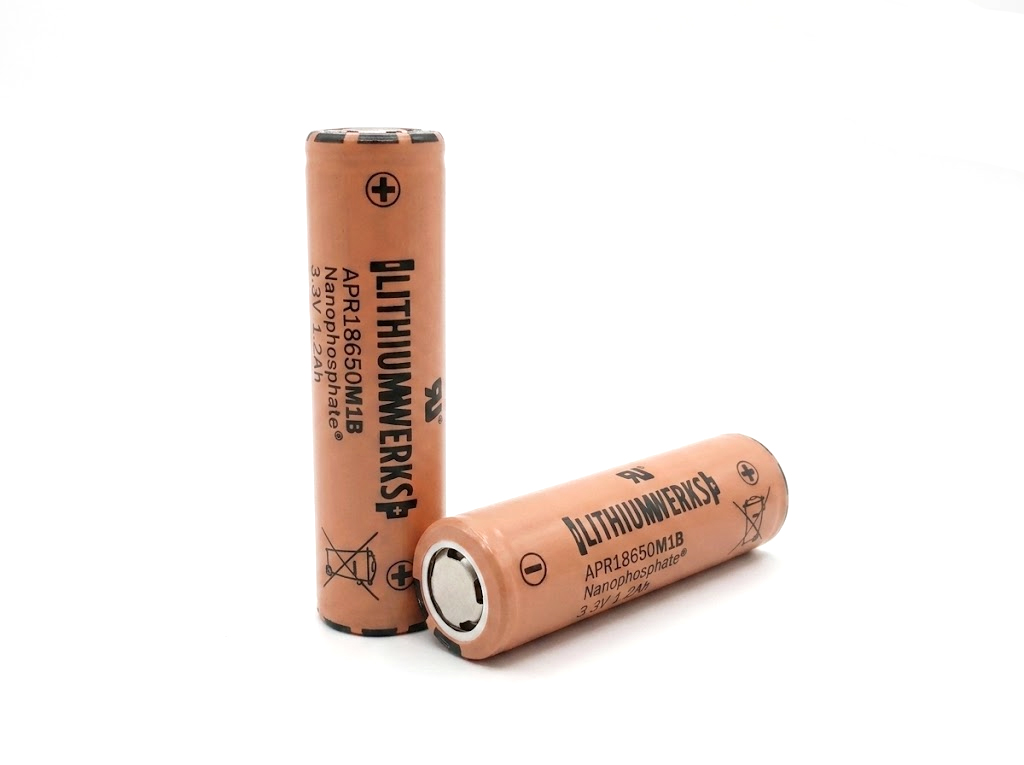
The APR18650M1B is an 18650-format lithium iron phosphate cell manufactured by LithiumWerks. It uses LiFePO4 chemistry — the iron phosphate cathode material that engineers have standardized on for applications that need safe lithium battery chemistry without compromising on power output.
This cell is rated for 30A continuous discharge, which is high for an 18650 cylindrical battery cell. The 50A pulse discharge rating makes it practical for applications with sharp, repetitive load spikes — engine starting, motor drives, power tools, and similar uses.
At a 3.3V nominal voltage and 1.2Ah typical capacity, each cell stores 3.96Wh of usable energy. That is not the highest energy density available in the 18650 format. LiFePO4 trades some energy density for a substantially safer electrochemical profile and far better cycle life compared to NMC or NCA chemistries.
The APR18650M1B cell is a direct descendant of the original A123 Systems Nanophosphate technology — the same platform that established LiFePO4 cells in motorsport, defense, and grid storage applications more than a decade ago.
LithiumWerks manufactures the APR18650M1B. The company acquired the Nanophosphate battery technology and manufacturing assets from A123 Systems and has continued developing and supplying this cell for industrial, commercial, and specialty markets.
LithiumWerks operates as both a cell manufacturer and a solutions provider. They supply the APR18650M1B cell directly to OEM customers building battery packs, as well as through a network of authorized distributors.

Most engineers who specify an 18650 lithium iron phosphate cell are making a deliberate trade. You give up some energy density relative to NMC. In return you get:
For applications where cell failure could cause fire, injury, or system damage, inherently safe chemistry is not a marketing feature — it is an engineering requirement. The APR18650M1B meets that requirement.
The table below summarizes the key electrical and mechanical specifications for the APR18650M1B. Always confirm against the current LithiumWerks APR18650M1B datasheet before finalizing a design, as specifications are subject to revision.
| Parameter | Value |
|---|---|
| Nominal Voltage | 3.3V |
| Typical Capacity | 1.2Ah |
| Minimum Capacity | 1.15Ah |
| Nominal Energy | 3.96Wh |
| Continuous Discharge Current | 30A |
| Peak / Pulse Discharge Current | 50A |
| Chemistry | LiFePO4 (Lithium Iron Phosphate) |
| Cell Format | 18650 Cylindrical |

The LithiumWerks APR18650M1B datasheet covers electrical performance curves, mechanical dimensions, charge and discharge specifications, operating temperature ranges, storage conditions, and handling requirements. It also includes capacity versus discharge rate curves and temperature derating information.
Buyers evaluating this cell for a new design should download the current datasheet directly from LithiumWerks or from an authorized distributor. The datasheet is the authoritative document for design work. Specifications shown on third-party sites may be outdated.
Key electrical parameters for the APR18650M1B technical data summary:
Mechanical parameters including APR18650M1B dimensions and APR18650M1B weight conform to standard 18650 form factor specifications. Confirm exact values from the current datasheet for tooling and housing design.
The APR18650M1B is not a general-purpose 18650 cell. It is engineered specifically for high-current applications. The features that define it:

In practical terms, this cell outperforms conventional 18650 LiFePO4 cells in power delivery. The 30A continuous and 50A pulse ratings are well above what most competing 18650 LiFePO4 cells are rated for. This comes from the low internal resistance enabled by the Nanophosphate structure.
The high discharge 18650 battery design also means the cell runs cooler at high rates. A cell that heats up less during discharge degrades more slowly, which contributes to the long cycle life battery cell performance documented in LithiumWerks’ own testing.
Float reliability is another practical highlight. The APR18650M1B performs well in float or standby applications — relevant for UPS, telecom backup, and grid storage — where cells sit at high state of charge for extended periods. LiFePO4 chemistry handles this condition better than other lithium chemistries.
Choosing an 18650 LiFePO4 cell over a higher-energy NMC cell makes sense when:
The APR18650M1B checks all of these boxes. The 18650 format keeps it compatible with standard cell holders, pack structures, and assembly tooling.
The APR18650M1B is rated for:
These numbers reflect the low internal resistance of the Nanophosphate cathode. Most 18650 lithium iron phosphate cells from other manufacturers are rated in the 10–20A continuous range. The APR18650M1B is designed to operate at rates that would push competing cells into thermal stress.
Capacity delivered at high discharge rates does decrease, as with all electrochemical cells. The LithiumWerks APR18650M1B datasheet includes rated capacity at different C-rates. Plan pack sizing around the discharge rate your application actually uses, not just the standard 0.2C test condition.

The APR18650M1B supports fast charge capability compared to standard LiFePO4 cells. LiFePO4 chemistry is generally more tolerant of higher charge rates than NMC, and the Nanophosphate structure extends this advantage further.
Standard charging follows a CC-CV (constant current, constant voltage) profile. Charge voltage, current limits, and cutoff parameters are specified in the LithiumWerks APR18650M1B datasheet. Do not use charging parameters from a different LiFePO4 cell without confirming they match the APR18650M1B specification — internal resistance and acceptance current differ between Nanophosphate cells and conventional LiFePO4 cells.
The stable voltage output of the APR18650M1B makes it particularly useful in applications where the load expects consistent input voltage. The LiFePO4 discharge curve is flat through most of the capacity window, then drops sharply near depletion. This behavior:
Combined with the high pulse discharge capability, this makes the APR18650M1B cell well suited to both steady-load applications like telecom backup and variable-load applications like electrified mobility and power tools.
The APR18650M1B long cycle life cell characteristic is one of the primary reasons engineers specify this cell over NMC alternatives. LiFePO4 chemistry undergoes less structural degradation at the cathode during cycling than cobalt-based materials. The Nanophosphate formulation compounds this advantage at the particle level.
Specific cycle life figures are documented in the LithiumWerks APR18650M1B datasheet and depend on depth of discharge, temperature, and charge/discharge rate. In general, LiFePO4 cells of this class are designed for thousands of cycles at 80% depth of discharge before falling below 80% of initial capacity.
For buyers calculating total cost of ownership on a battery pack, this cycle life figure directly affects pack replacement interval and lifetime cost.
The APR18650M1B safe 18650 LiFePO4 cell design relies on material-level safety rather than external protection devices alone. Key safety characteristics:
These properties make the APR18650M1B a preferred cell in applications requiring safe lithium battery chemistry under regulatory scrutiny: medical devices, aerospace, defense, and public transportation.

The lithium iron phosphate battery cell chemistry has a track record that other lithium chemistries lack at scale. The P–O bond in the phosphate structure is significantly stronger than the metal–oxide bonds in NMC or NCA. This structural stability does two things simultaneously: it limits the energy released in a fault condition and it reduces the cycle-by-cycle degradation that shortens cell life.
The APR18650M1B cycle life and APR18650M1B safety features are not independent attributes — they are both consequences of the same underlying chemistry. Designing with this cell means accepting a slight energy density penalty in exchange for a cell that will still be performing reliably five to ten years into service.
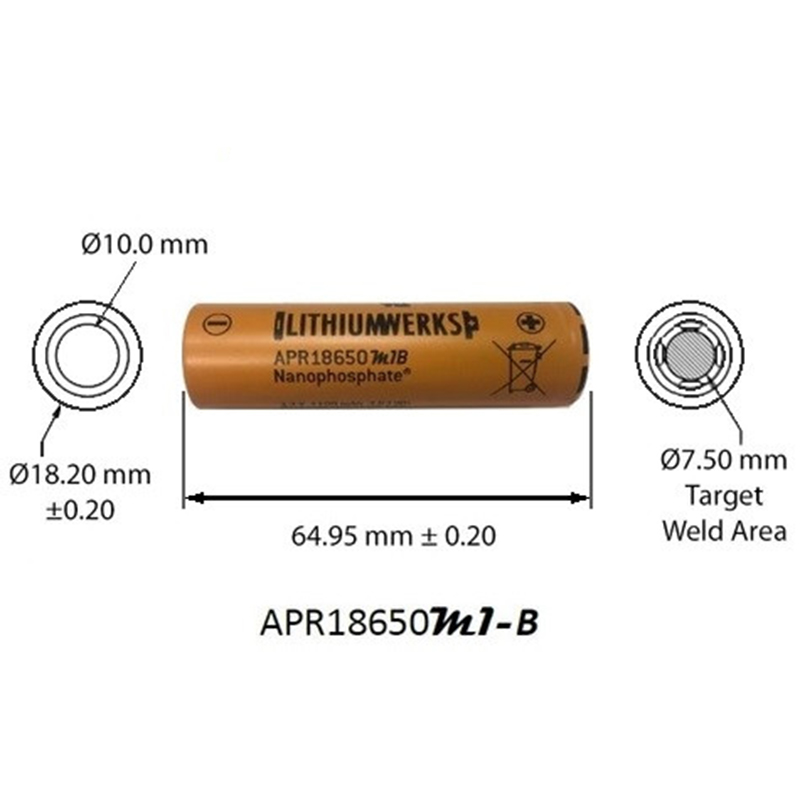
The APR18650M1B follows the standard 18650 cylindrical format. The “18650” designation encodes the nominal dimensions: 18mm diameter and 65mm length. Exact APR18650M1B dimensions including tolerance bands are specified in the official LithiumWerks datasheet.
When designing cell holders, module housings, or pack structures, always verify the exact dimensional specification rather than assuming nominal 18650 values. Manufacturing tolerances vary slightly between cell producers, and interference fits can damage cells.
APR18650M1B weight is specified in the LithiumWerks datasheet. For system-level energy density calculations, combine the cell weight with the 3.96Wh energy content to derive gravimetric energy density per cell. Pack-level density will be lower once you account for BMS, cabling, housing, and thermal management.
The wide temperature performance of the APR18650M1B is a notable advantage over standard lithium ion cells. LiFePO4 chemistry maintains usable capacity at lower temperatures than NMC, though all lithium chemistries exhibit capacity reduction in cold conditions.
Operating temperature ranges for charge and discharge are separately specified in the LithiumWerks datasheet — charge temperature limits are more restrictive than discharge limits for this cell, as is typical for all lithium chemistries. Do not charge at or below 0°C without verifying the specific low-temperature charge limit from the datasheet.
Specific temperature ranges for discharge and charge are found in the LithiumWerks APR18650M1B datasheet.
For APR18650M1B storage conditions, follow the LithiumWerks datasheet recommendations on:
These are standard precautions for lithium cells. The APR18650M1B’s inherently stable chemistry does give it relatively good storage characteristics compared to higher-energy lithium chemistries.
The APR18650M1B is used across a wide range of applications, all of which benefit from its combination of high power output, long cycle life, and safe lithium battery chemistry. Documented and typical application areas include:

The APR18650M1B is designed for use in multi-cell battery packs. Its compact cylindrical format, standardized dimensions, and well-characterized electrochemical behavior make it straightforward to integrate into custom pack designs.
For APR18650M1B battery pack use and assembly:
The APR18650M1B is a strong candidate for 18650 battery for battery packs where the 30A per cell or 50A pulse per cell rating is needed to meet system current requirements without oversizing the pack.
Beyond the listed application categories, any application that previously used lead-acid, NiMH, or lower-performance lithium cells and is facing cycle life or safety limitations is a candidate for the APR18650M1B. The migration to 18650 LiFePO4 cells typically involves:
The APR18650M1B power cell’s well-documented behavior and long field history simplify this transition compared to newer or less-established cell chemistries.
Certification status for the APR18650M1B should be confirmed directly with LithiumWerks or your authorized distributor, as certifications are subject to change and may vary by production lot or market. LiFePO4 cells of this type are commonly tested and certified under:
For specific APR18650M1B certifications applicable to your application and market, request the current certification package from LithiumWerks or your supplier. Do not rely on certification status from third-party listings without verification.
For APR18650M1B compliance with application-specific regulations — including medical device battery requirements, aerospace battery standards, or grid storage regulations — engage LithiumWerks’ technical sales team directly. Compliance documentation requirements vary significantly by industry and jurisdiction.
Shipping and handling compliance (including IATA, IMDG, and DOT requirements for lithium batteries) is governed by UN 38.3 test results and the cell’s watt-hour rating. The APR18650M1B at 3.96Wh per cell falls within standard lithium cell transport categories.
LithiumWerks provides technical documentation to support customers’ regulatory submissions, including material safety data sheets (MSDS/SDS), test reports, and product specifications. If your application requires a specific certification or test report not currently available, contact LithiumWerks to discuss testing options.
For OEM customers building regulated products — medical devices, aerospace components, or transportation equipment — early engagement with the cell manufacturer on APR18650M1B certifications and compliance documentation avoids delays late in the product development cycle.
LithiumWerks is the original equipment manufacturer of the APR18650M1B. The company designs, manufactures, and sells Nanophosphate LiFePO4 cells and battery solutions. They maintain technical support resources for OEM customers, including access to application engineers for pack design support.
For customers who need to verify the APR18650M1B manufacturer for supply chain documentation or regulatory purposes, LithiumWerks is the party of record for this cell’s design and production.
The APR18650M1B is available through:
For APR18650M1B wholesale or APR18650M1B bulk order inquiries, contact LithiumWerks or an authorized distributor for current lead times, minimum order quantities, and APR18650M1B price tiers. Pricing varies by volume, contract structure, and market conditions. Request a formal quotation for project budgeting.
If you are evaluating an APR18650M1B supplier that is not LithiumWerks or an authorized distributor, verify that the cells are genuine LithiumWerks product. Counterfeit or substitute cells in the 18650 market are a real risk, particularly for popular high-performance cells.
For OEM customers and volume buyers, LithiumWerks offers:
APR18650M1B manufacturer direct engagement is recommended for any project requiring more than sample quantities, custom specifications, or regulatory support. Reach out through LithiumWerks’ official contact channels for an APR18650M1B supplier inquiry or APR18650M1B bulk order quote.
The APR18650M1B power cell is a 3.3V, 1.2Ah lithium iron phosphate (LiFePO4) rechargeable cell manufactured by LithiumWerks. It uses Nanophosphate battery technology to achieve 30A continuous discharge and 50A pulse discharge in a standard 18650 cylindrical form factor. It is designed for high-power applications including telecom backup, UPS, energy storage, medical devices, and electrified mobility.
The LithiumWerks APR18650M1B datasheet is available directly from LithiumWerks and from authorized distributors. The datasheet contains full electrical specifications, mechanical dimensions, charge and discharge parameters, operating temperature ranges, and storage conditions. Always confirm you have the current revision before finalizing a design.
Key APR18650M1B specifications include: 3.3V nominal voltage, 1.2Ah typical capacity (1.15Ah minimum), 3.96Wh energy per cell, 30A continuous discharge current, 50A peak pulse discharge current, low internal resistance, and standard 18650 cylindrical dimensions. Full LithiumWerks APR18650M1B specifications are in the official datasheet.
The APR18650M1B is suitable for UPS systems, telecom and 5G battery backup, grid and distributed energy storage, medical devices, industrial equipment, electrified mobility platforms, engine starting systems, and aerospace applications. Any application requiring high discharge current, long cycle life, and inherently safe lithium battery chemistry is a candidate.
Yes. The APR18650M1B is specifically designed for APR18650M1B battery pack assembly into multi-cell modules. Its standardized 18650 dimensions, well-characterized LiFePO4 electrochemistry, and high discharge ratings make it a practical choice for custom pack designs. Use a BMS configured for LiFePO4 voltage thresholds and include thermal management appropriate for the discharge rates involved.
LithiumWerks is the APR18650M1B manufacturer. The cell is available through LithiumWerks direct and through an authorized APR18650M1B supplier network. For APR18650M1B wholesale, APR18650M1B bulk order, or APR18650M1B price inquiries, contact LithiumWerks or an authorized distributor. For OEM programs, direct engagement with LithiumWerks is recommended.
Page last reviewed: 2025. Specifications are subject to change. Always refer to the current LithiumWerks APR18650M1B datasheet for design-critical parameters.